

ABBA and Céline Dion came to the world’s attention thanks to the Eurovision Song Contest, an annual showcase of pop music, camp and spectacle.
Filipino singer Carmelle is hoping that the Eurovision Song Contest Asia will serve as a similar springboard to international fame. On Nov. 14, 2026, Carmelle bested entries from 11 Asian countries to be crowned the Asian edition’s first-ever winner. The competition marked Eurovision’s boldest expansion of its format in its 70-year history.
As a scholar of contemporary European popular music and politics, I study the ways in which Eurovision shapes notions of what it looks like and sounds like to be European. Knowing that the Asian edition would be organized by European broadcasting executives, I wanted to see how closely Eurovision Asia would resemble the flagship Eurovision, or whether it would carve out an identity of its own.
Eurovision’s proposed expansion into Asia dates back to 2008, when the European Broadcasting Union – the transnational coalition of public service media organizations that has organized the Eurovision Song Contest since 1956 – announced plans for “Our Sound – The Asia-Pacific Song Contest.” Originally slated to debut in 2010, the project never materialized.
On March 31, 2026, however, Voxovation, a European-led production company that oversees the development of Eurovision’s spinoffs, announced that Bangkok would host the inaugural Asian competition in partnership with Thailand’s Channel 3 and S2O Productions.
Eurovision Asia is now the second European Broadcasting Union-licensed global spinoff to make the airwaves.
In 2022, Voxovation organized the American Song Contest, which included original songs by artists from all 50 U.S. states, five territories and Washington.
Despite being promoted to the American public in a Super Bowl commercial featuring hosts Kelly Clarkson and Snoop Dogg, the competition failed to attract a large viewership and the spinoff wasn’t renewed.
Given two decades of uncertainty, as well as the failure of Voxovation’s U.S. spinoff, some critics doubted whether the Asian version would succeed. And for a moment, it looked like everything might fall apart: In late October 2026, the Swedish newspaper Aftonbladet reported that Eurovision Asia’s original budget of approximately US$4.5 million had been reduced by US$1 million.
The European Broadcasting Union, however, confirmed that the show would go on as planned, and at 8:30 p.m. Bangkok time on Nov. 14, the show’s two hosts, Thai media personalities Woody Milintachinda and Cindy Bishop, welcomed viewers from around the world tuning in via television broadcast and the YouTube livestream.
“Maybe you’ve never heard of Eurovision before, or maybe you’re one of the hardcore Eurofans,” said Bishop. “It doesn’t matter, because you will be blown away by the talent here tonight!”
For the next two-and-a-half hours, each country’s representative performed an original song, with Vietnam’s Tóc Tiên opening the show with her song “Em Tiên” (“Fairy Maiden”).
Vietnam’s entry had many of the spectacular ingredients of an ideal Eurovision entry: bilingual lyrics, large props, flashy outfits and a dance break. The song’s instrumentation included a flute accompanying Tiên’s melody and a bamboo xylophone. It concluded with a second, high-energy dance break reminiscent of electronic dance music genres.
The song’s use of traditional Asian musical signifiers followed the approach of the European entrants that have incorporated folk traditions to promote their national cultures to an international audience.
For example, Ukraine’s 2004 winning entry, Ruslana’s “Wild Dances,” opened with the trembita, a long alpine horn associated with the Hutsul people of the Carpathian Mountains. Armenia’s 2008 entry, Sirusho’s “Qele, Qele,” similarly combined a traditional Armenian duduk flute, zurna trumpet and dhol drums with an upbeat dance track and contemporary pop vocals. While some scholars claim that these musical gestures strategically romanticize and exoticize regional cultures, it’s a way to fuse national identity with modern music.
Other Eurovision Asia entrants also pulled from this playbook. Mongolia’s singer, Beck, wore a deel, the country’s traditional robe, while performing. He also incorporated a traditional Mongolian string instrument into his performance.
Voting, which was open to the general public via an online form, began just before the first performance. Viewers were allotted eight free votes, on the condition that they had to vote for at least three different countries. They could purchase 10 additional votes. The public accounted for half the votes, while a jury made up of representatives from each nation accounted for the other half.
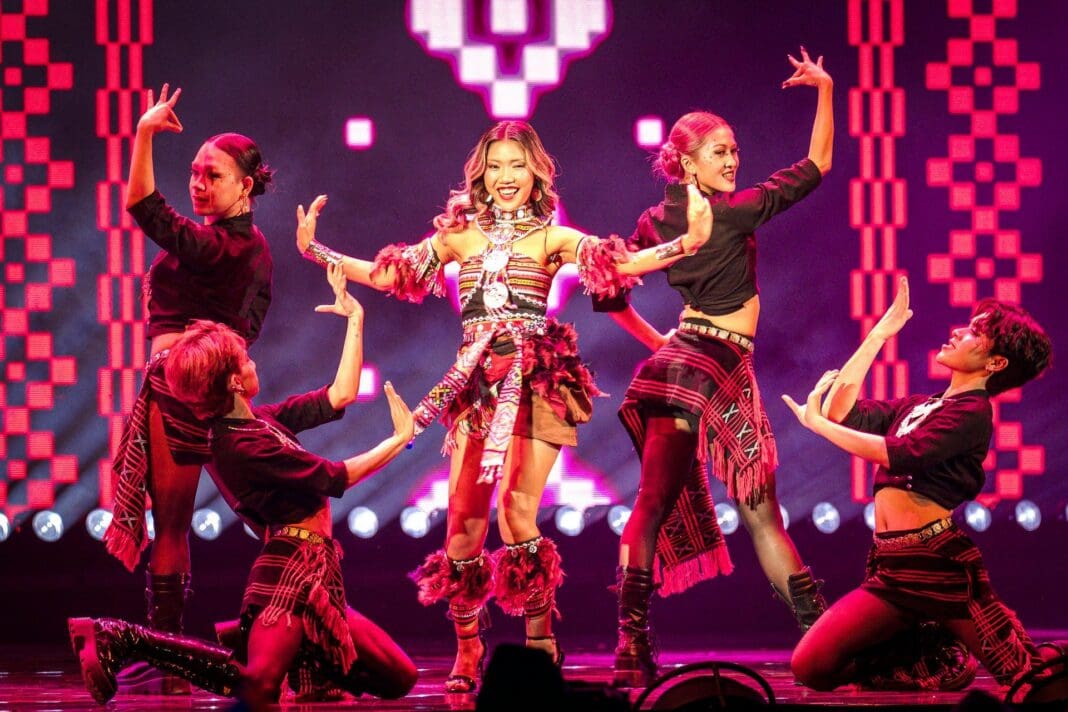
Carmelle’s winning song – a Filipina women’s empowerment anthem titled “Sobra-Sobra” (“Too Much”) – featured a repeated musical line played by a kulintang, a Filipino percussion instrument, and a frenetic dance break. The song’s bridge was rapped in Tagalog, the country’s national language.
As part of her reward, Carmelle will perform “Sobra-Sobra” at the 2027 Eurovision Song Contest in Burgas, Bulgaria.
No Eurovision competition would be complete without a measure of political controversy.
From broadcaster boycotts over Israel’s participation amid the war in Gaza to suspicions that Franco’s Spain rigged the 1968 Eurovision vote in its favor, political disputes have long been part of the competition.
Normally, political statements are not permitted in Eurovision, though exceptions have been made for humanitarian causes. Ukraine’s victory in Eurovision 2022 took place just a few months after Russia’s full-scale invasion of the former Soviet republic. Oleh Psiuk, the frontman of Ukraine’s entrant, Kalush Orchestra, pleaded for support for Ukraine at the end of the performance, which the European Broadcasting Union ended up allowing.
During Eurovision Song Contest Asia, Malaysia found itself at the center of controversy.
Malaysian entrant Aina Abdul, who wears a hijab in her public appearances, performed her song “Bluest Sky.” While Abdul was seen as a possible favorite, Malaysian audiences claimed that she ultimately did not score enough points due to Islamophobia.
Another controversy arose due to the Malaysian broadcaster TV3’s coverage of the show. During the results segment at the end of the show, the camera feed of the Filipino spokesperson, the drag queen Vice Ganda, was cut from the Malaysian broadcast. Malaysian broadcasting laws restrict the airing of drag and LGBTQ+ content on television, radio and digital platforms.
In a comment to The Guardian, Eurovision Director Martin Green said, “We are surprised and disappointed to learn that the broadcast of Eurovision Song Contest Asia was altered in Malaysia.”
“We take this matter seriously and will be writing to Voxovation,” Green added.
TV3 has yet to comment on the incident.
Here, there are also echoes of the European competition: Eurovision has embraced multicultural and pro-LGBTQ+ values to such an extent that countries like Hungary and Turkey have withdrawn due to their governments’ incompatible sociopolitical values.
Eurovision Asia’s controversies prove that the European Broadcasting Union has a new – perhaps unexpected – set of geopolitical and sociopolitical values to navigate.
Television viewership for Eurovision Asia varied by market. In Vietnam, the show reached over 5 million viewers. The host country’s broadcast, however, only reached an average of 385,000 Thai viewers. These numbers pale in comparison to Eurovision 2026’s viewership of 131 million viewers across the 35 competing nations.
Nonetheless, hype is already building for the 2027 edition of Eurovision Asia. During a news conference in Bangkok, Voxovation executive Christer Björkman confirmed that multiple cities have expressed interest in hosting, with China, Japan and Taiwan indicating that they’re open to participating in the future.
If more Asian broadcasters buy in, Eurovision will attract an even larger international audience, bringing Voxovation one step closer to turning the contest from a European tradition into a global phenomenon.
But time will tell whether Eurovision Asia can become something more than a European competition staged elsewhere.
This article is republished from The Conversation, a nonprofit, independent news organization bringing you facts and trustworthy analysis to help you make sense of our complex world. It was written by: Paul David Flood, University of Tennessee
Read more: The 12th‑century Chinese poet who was among the first to explore the inner lives of cats Filipino sailors dock in Mexico … and help invent tequila? ‘The Eternal Queen of Asian Pop’ sings one last encore from beyond the grave
Paul David Flood does not work for, consult, own shares in or receive funding from any company or organization that would benefit from this article, and has disclosed no relevant affiliations beyond their academic appointment.