

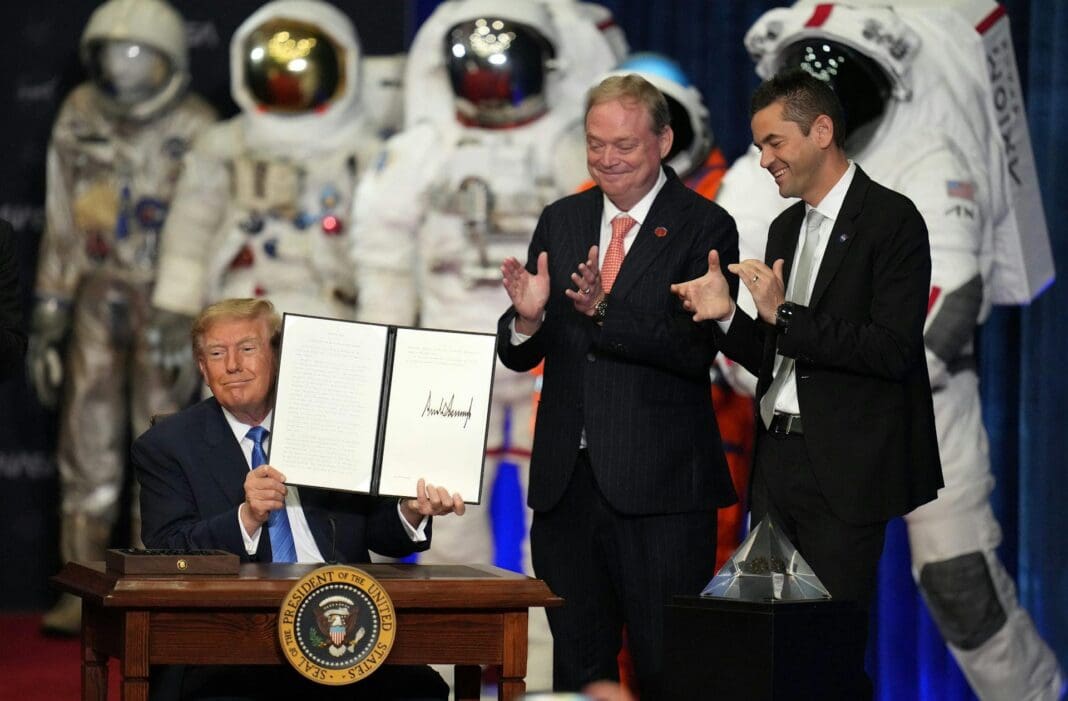
During a visit to NASA’s Johnson Space Center in Houston on Aug. 28, 2026, President Donald Trump signed an executive order to create a United States Space Academy.
The proposal, which would establish a NASA-led institution set up along the lines of a military academy, is a new one. As a space policy expert, I see several open questions and potential problems related to the vision Trump’s executive order described.
During his first term in office, Trump undertook several actions supporting space exploration.
He established the Artemis program, to return astronauts to the Moon, in 2017. A year later, he announced his support for a new branch of the military dedicated to space. In 2019, this became reality with the establishment of the Space Force.
Given this record, it’s not surprising that Trump has continued to show interest in space during his second term.
During his remarks in Texas, Trump stated that the U.S. Space Academy will “serve both the United States Space Force as well as NASA and the civilian spaceflight industry.” Further, he said the school would be comparable to the other service academies such as West Point, the U.S. Air Force Academy and the U.S. Naval Academy.
The actual executive order doesn’t create a space academy outright. It establishes a commission that must gather information and give a report within 120 days about the feasibility of a U.S. Space Academy. The commission will be led by Jared Isaacman, the NASA administrator, and will include, among others, the secretary of defense, the national security adviser and the director of the Office of Management and Budget.
That order says the academy would “develop a professional corps of civically grounded leaders prepared to advance American interests within the space domain.” As a NASA-led federal academy, it would be the first nonmilitary service academy that the government would run. The commission would then determine what exactly would be taught.
Both Trump’s speech and the executive order leave several open questions. First, former NASA leaders and members of Congress have expressed concerns about the relationship between a space academy and the military.
The president’s comparison of the space academy to the military academies and his use of the Space Force in justifying a space academy contradict the executive order’s description of the effort as NASA-led, as NASA is not part of the military.
This confusion even extends into reporting on Trump’s order, with news outlets running headlines like “A West Point for Space?” Since the 1950s, American space policy has separated civilian space efforts like NASA from military ones. While this division hasn’t always been perfect, the U.S. Space Academy proposal reignites a debate over this civilian-military split.
This leads to another question about what a space academy would teach. Military academies like West Point combine military training and education with typical college degree programs like engineering or the social sciences. It remains unclear what a space academy would teach and how much of its curriculum would be about military uses of space, versus exploration and science.
The executive order opens up other questions about the academy’s relationship to civilian and military space programs. These include whether there are any potential obligations to serve in the Space Force and the extent to which Space Academy students would receive military-specific training.
A second problem involves Congress. Not only is Congress responsible for establishing new bureaucratic organizations, but it must also provide funding for them. So, congressional action will be required to actually create the U.S. Space Academy.
While getting the exact funding numbers for the military service academies is difficult, one member of Congress estimated that each service academy costs roughly US$1 billion per year. Starting an entirely new academy would require significantly more than that. If, as the executive order suggests, NASA would lead the academy, funding may be even more difficult because funding NASA is not mandatory. In fact, it is often one of the first agencies to suffer budget cuts.
Other questions also remain: How will students be selected? Or will they apply? Where will the academy be located? And what degrees will it offer?
Establishing the U.S. Space Academy could be a wise decision, as space is becoming more important in everyday life. The pace of space activities – civilian, commercial and military – has increased significantly in the past decade and is poised to continue. For example, satellite constellations like SpaceX’s Starlink provide internet access globally, and the Global Positioning System, GPS, is a vital part of the economy worldwide. A space academy could help educate the next generation of engineers, scientists and spacecraft operators.
But the biggest implication of this space academy proposal is that it would almost certainly lead to a reconsideration of the relationship between military and civilian space. The distinction between these two areas has been a cornerstone of U.S. space policy for over 65 years. While the lines have been blurred at times, a U.S. Space Academy that serves as both a military and civilian institution confuses them even further.
As tensions in space between the United States and its potential adversaries continue to rise, balance will be necessary to avoid any potential escalation. Space activities that are civilian in nature, like scientific exploration, should not be confused with those that are distinctly military related, such as missile warning or defense, that might be seen as more aggressive. Keeping this distinction clear will help to clear up any confusion about U.S. intentions in space.
It will also be important to define the precise purpose of the space academy and who exactly it will serve. What advantage does a space academy offer over civilian schools and universities that offer similar programs? Will commercial space companies have an opportunity to be involved? And what would that look like?
While some might see the proposed U.S. Space Academy as a step on the way to Star Trek’s Starfleet Academy, there are many real-world questions that need to be answered first.
This article is republished from The Conversation, a nonprofit, independent news organization bringing you facts and trustworthy analysis to help you make sense of our complex world. It was written by: Wendy Whitman Cobb, Air University
Read more: Space Force sounds like a joke thanks to pop culture – that could be a problem for an important military branch How US military planning has shifted away from fighting terrorism to readying for tensions and conflict with China and Russia Both Harris and Trump have records on space policy − an international affairs expert examines where they differ when it comes to the final frontier
Wendy Whitman Cobb is affiliated with Air University. The opinions and conclusions expressed are those of the author and do not reflect the official policies or positions of the United States Air Force, the Department of War (Defense), or any other U.S. Government agency. Mention of trade names, commercial products, or organizations do not imply endorsement by the U.S. Government.