

Did the founders of the United States intend to create a Christian nation?
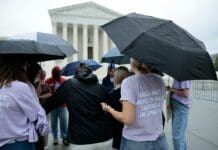
Political leaders who addressed a prayer rally on the National Mall on May 17, 2026, seem to think so: House Speaker Mike Johnson led the crowd in “rededicat(ing) the United States of America as one nation under God.”
Some, and perhaps many, scholars would say no: that while many founders were religious, as a group they concluded that the national government should not support any particular faith.
As a scholar of Colonial North America, I believe that history provides an answer. European colonizers in lands that became the United States did link church and state. But the architects of the new nation broke from that idea as surely as they broke from Britain.
The European desire to expand the boundaries of Christendom played a central role in the Colonial era, as I describe in my 2026 book, “Contested Continent.”
That drive mattered greatly to Christopher Columbus, who sailed west in 1492. Upon landing in the Bahamas, he laid claim to already populated territories, writing that Christ would rejoice “as he foresees that so many souls of so many people heretofore lost are to be saved.”
The “Doctrine of Discovery,” proclaimed by the Vatican in 1493, granted European monarchs title over lands occupied by non-Christians and urged them to convert the people who lived there.
Less than a generation later, the Protestant Reformation transformed Christianity, dividing Europe and spawning brutal violence.
In England, the schism reshaped the relationship between church and state. King Henry VIII severed ties with the pope in the 1530s. He ordered the dissolution of monasteries, and his followers defaced church statues of Catholic saints.
After Henry rejected Rome’s authority, Parliament passed the Supremacy Act of 1534, which made the monarch the leader of an independent national church, the Church of England.
Queen Elizabeth I, Henry’s daughter, further reduced the political power of English Catholics in 1559. Her desire to promote her Protestant faith, along with a yearning to expand England’s political authority, helped fuel a vicious campaign to take control of Ireland, where the Reformation’s teachings had not taken hold.
The desire to promote Protestantism also figured in English plans for the colonization of North America.
In the 1580s, an expedition sent by Sir Walter Raleigh arrived on the Outer Banks of what is now North Carolina. They were eager to learn about the region’s natural resources and its peoples. English colonial planners also hoped to convert Carolina Algonquians, and to keep Catholics away. A small group of Jesuit priests had already tried to establish a mission on a tributary of Chesapeake Bay in 1571, but they were killed by Indigenous people.
Thomas Harriot, who chronicled the English efforts when he arrived in 1585, believed that Carolina Algonquians would convert to Protestantism. In fact, he wrote, Native people were so eager to accept the faith that they grabbed a Bible “to embrace it, to kisse it, to hold it to their bre(a)sts” in order to absorb the lessons it contained.
In 1607, the Virginia Company of London established a settlement at Jamestown, promising, according to the colony’s 1609 charter, that colonization would lead to “the conversion and reduccion of the people in those partes unto the true worshipp of God and Christian religion.” To advance their goal, they tried to bar anyone holding “the superstitions of the Churche of Rome.” Colonists had to swear the oath of supremacy to the English monarch, which meant accepting the Church of England.
Within a generation, other Protestants arrived in English America, including critics of the Church of England who are now often called “Pilgrims.” Puritans, who migrated soon after, held similar beliefs. Persecuted in England for their dissenting views, they arrived eager to demonstrate to the world that they knew the best ways to advance a civilization, based on their interpretation of Scripture.
Among these migrants was John Winthrop, a leader of the Massachusetts Bay colony. In 1630, he wrote what became the most famous sermon in early America – although he was not a minister and likely never delivered it to a congregation.
Winthrop advocated the blending of church and state. As he put it, drawing on the Bible’s Book of Matthew, “We shall be as a city upon a hill. The eyes of all people are upon us.” Colonists’ failure, he suggested, would be a victory for the enemies of God.
English advocates of colonization were aware that Catholics had been erecting churches in modern-day Mexico and Peru. Protestants feared that Rome’s influence might spread across the East Coast, moving southward from French Canada and northward from Spanish Florida. While English authorities allowed limited migration of Catholics, especially to Maryland, their Colonies remained Protestant strongholds.
No single official church establishment stretched across the 13 Colonies that would eventually join in the American Revolution. But church and state were closely related in each.
Towns across New England taxed residents to support local Congregational churches, which evolved out of Puritan traditions. Colonial governments established the Church of England in Virginia in 1619 and in New York in 1693.
Pennsylvania’s 1682 frame of government promised that law-abiding people would not be persecuted for their religious views or forced to worship. But those who held public office needed to “possess faith in Jesus Christ.” Even Rhode Island, famous for its tradition of tolerance, specified in its 1663 charter that residents should edify “themselves, and one another, in the holie Christian faith.”
By the mid-1770s, many Colonial Americans decided that the time had come to separate from Great Britain. Many also wanted to separate church and state.
In 1777, just a year after he drafted the Declaration of Independence, Thomas Jefferson wrote Virginia’s Statute for Religious Freedom. As he put it, one’s ability to serve the public should “have no dependance on our religious opinions, any more than on our opinions in physics or geometry.” When the statute became law in Virginia in 1786, it protected freedom of worship and ended taxes to support the Church of England.
Article 6 of the United States Constitution, written in Philadelphia in 1787, forbade any religious oaths for those who wanted to hold office. The First Amendment, which became part of the Constitution in late 1791, held that Congress “shall make no law respecting an establishment of religion, or prohibiting the free exercise thereof.”
The leaders of the American Revolution did not agree on all matters of faith. But had they wanted public support of religious institutions, they had plenty of models at hand – including the Church of England.
They decided, instead, that a durable republic could best survive if politics and religion inhabited different spheres. This recognition contradicted almost two centuries of Colonial practice, making it among the most radical achievements of the founding era.
This article is republished from The Conversation, a nonprofit, independent news organization bringing you facts and trustworthy analysis to help you make sense of our complex world. It was written by: Peter C. Mancall, USC Dornsife College of Letters, Arts and Sciences
Read more: Beyond Disney: A 1616 portrait of Pocahontas shows how English colonizers saw Indigenous Americans Pepper pot stew was survival food for the poor and a path to freedom for Black women in early Philadelphia What the Declaration of Independence does – and doesn’t – say about God
Peter C. Mancall has received funding from the Huntington Library, the National Endowment for the Humanities, and the Mellon Foundation.