

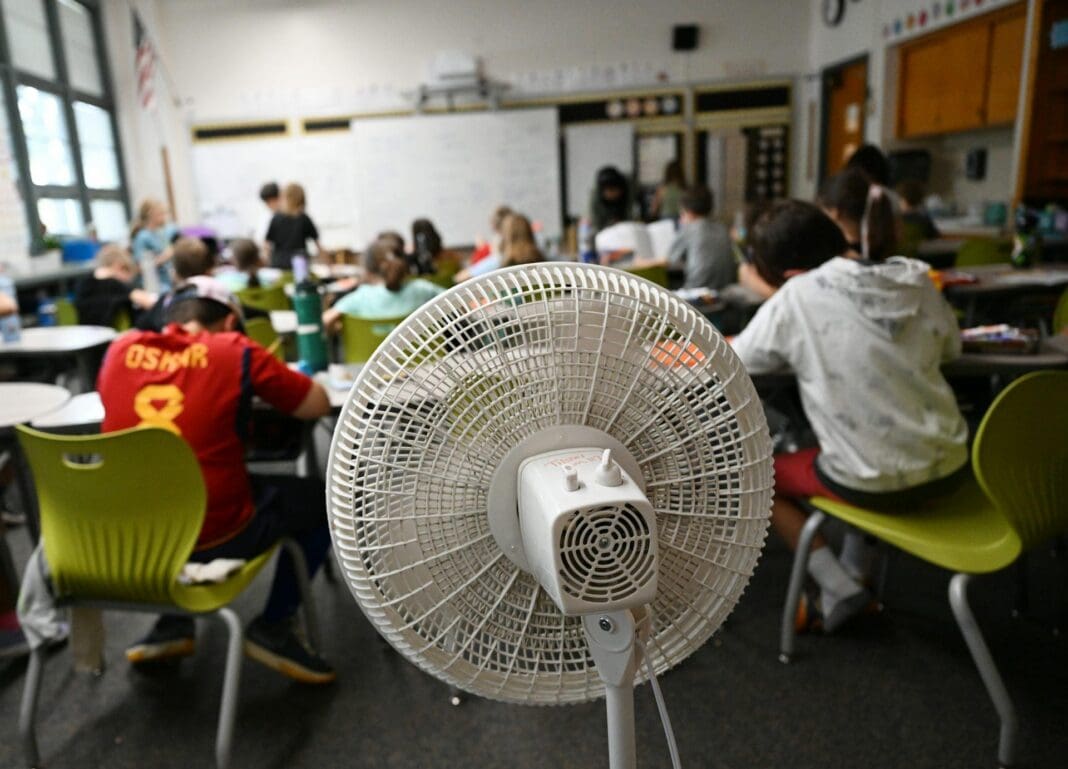
As temperatures in Phoenix soared to 117 degrees Fahrenheit, or 47 degrees Celsius, in July 2026, children living there headed outside to walk to and from school, play during recess and suit up for baseball practice.
These routines have long been part of the school day, but with a rising number of school districts in Arizona, as well as across the country, starting their academic year in mid-July or August, kids are spending more time at school during some of the hottest days of the year.
Heat doesn’t just affect places like Phoenix, which is well known for its scorching temperatures that don’t always drop by much in the evenings.
Many U.S. cities, from Los Angeles to Houston, are oppressively hot when the new school year begins in August or September – and they are only getting warmer. The increased frequency, intensity and duration of extreme heat has become a common concern across many places in the United States and other countries.
We are Arizona State University researchers who study how extreme heat affects children when it comes to their outdoor school activities, physical activity, health and overall well-being.
Our work is part of HeatReady Schools, a program at Arizona State University that helps schools prepare for and mitigate the effects of heat.
We think it’s important to recognize that many schools are underprepared to carry out their days in extreme heat, without the physical infrastructure or planning to keep students and educators comfortable and safe while in the classroom or outside on school grounds.
The challenge of managing hot school days has intensified, as many U.S. schools have moved the start of the academic year earlier into the summer over the last several years.
School calendar changes are driven by multiple factors, including reducing summer learning loss, increasing instructional time to prepare for standardized testing, and responding to teacher and administrator preferences.
There are also federal policies aimed at improving chronically underperforming schools as well as state funding incentives like one in Arizona, which offers schools an additional 5% in annual funding if they extend their academic year from 185 to 200 days.
The growth of charter schools may be another contributing factor to this trend, as these schools have greater flexibility in setting their academic calendars.
About 60% of schools with earlier start dates are charter schools.
Exposure to hot environments puts students at risk of heat-related illnesses.
Yet many schools lack the infrastructure – from inadequate air conditioning to fields and play areas that are not shaded – to cope with high temperatures.
Most extreme heat illnesses in high school sports occur in July and August, and about one-third of these events happen without a school nurse or other kind of medic present.
Heat-related emergency department visits for school-age children are also highest during the warmest months.
Children are more vulnerable than adults to heat-related illnesses because of physical differences in their heat tolerance, limited recognition of heat stress signs and symptoms, and dependence on adults to implement protective measures.
Heat also affects learning.
School absence rates for students in K-12 schools are 16% higher on days when temperatures exceed 90 F (32 C).
Taking an exam on a hot day is linked to lower test scores. Adequate air conditioning in classrooms can mitigate this effect.
However, an estimated 41% of school districts with air conditioning in the U.S. need to update or replace their systems. Thirty-two days over 80 F (26.7 C) is the heat threshold where cooling systems are typically installed in schools.
In the U.S., 156 school districts serving over 1 million students saw at least 30 more days over 80 F during the school year in 2025 compared with 1970.
The cost to install new air conditioning systems in schools that lack them is estimated at US$40 billion. The cost to update existing systems in schools is estimated at more than $414 million.
Other countries are experiencing this problem as well. Thousands of schools closed or shortened their days across England, Wales and France because of the recent heat wave in Europe.
Many schools across the U.S. are working to tackle this challenge of keeping students and educators comfortable and safe while in the classroom or on the playground.
Contemporary playgrounds and schoolyards are often designed with minimal shade and artificial materials, like black rubber, concrete and aluminum, that can reach dangerously high surface temperatures when sun-exposed.
A growing number of schools are redesigning their campuses by planting trees, installing shade canopies and replacing hot materials with cooler, greener surfaces.
Adding shade in schoolyards improves thermal comfort by reducing the heat from the sun and air temperatures.
Spending time in shade also reduces student exposure to harmful sun exposure by 84% compared with being in the direct sun.
Research has found that children and teens are more active in schoolyards with greater tree cover and shade compared with less thermally comfortable areas.
Some states have passed laws to adjust sports schedules or provide additional equipment, training and staff to lessen the risk of heat-related illnesses. These policies, which in some cases also ensure that classroom temperatures be kept below a specific threshold of 82 F (27.8 C), are critical to support learning.
The recently released Heat Policy Agenda by the Federation of American Scientists also asks policymakers to create heat-safe schools in the U.S.
Lack of funding remains one of the biggest constraints to schools adapting to the likelihood of hotter days in and out of the classroom by retrofitting old buildings to have air conditioning, for example.
Many schools facing the most extreme heat are also those with the least amount of money available to spend.
Even adding outdoor shade is expensive. Large shade structures to cover playgrounds can cost tens of thousands of dollars.
Having large, air-conditioned indoor facilities so that traditional outdoor activities like physical education classes and sports practices can continue, even when it is very hot outside, is critical to support student learning and health.
However, many schools lack indoor space to support adequate movement, with only 46% of elementary schools in the West having dedicated gymnasiums. This compares with 60% of schools in the South, 73% in the Northeast and 77% in the Midwest.
Although peak temperatures vary across the U.S., July and August are generally the warmest months and have the highest heat indexes – considerably higher than many school end dates in May or June.
Considering aligning school calendars with regional climate conditions could help reduce student exposure to extreme heat while still meeting instructional needs.
Most school facilities and operations were not designed with current climate trends in mind. But we think that this reality should be regularly considered during planning and decision-making to support children’s learning, health and physical activity.
Adopting heat-adaptive practices, policies, designs and infrastructure will lessen the heat risk and support students as they learn, work and play during the hottest times of the year.
This article is republished from The Conversation, a nonprofit, independent news organization bringing you facts and trustworthy analysis to help you make sense of our complex world. It was written by: Allison Poulos, Arizona State University and Jennifer Vanos, Arizona State University
Read more: How to keep high school athletes safe from heat illness in a brutally hot summer Heat risk and young athletes — rising temperatures lead to lawsuits and environmental injustice Why 78 degrees isn’t the right thermostat setting for everyone during a heat wave
Allison Poulos receives funding from the National Science Foundation.
Jennifer Vanos receives funding from the National Science Foundation.