
The Trump administration’s Religious Liberty Commission released its report on June 26, 2026, on the state of religious freedom in the United States, declaring it to be under attack.
The commission was established in May 2025 to identify and report on “emerging threats to religious liberty, uphold Federal laws that protect all citizens’ full participation in a pluralistic democracy, and protect the free exercise of religion.” Despite those altruistic goals, from the beginning, the commission faced criticism that the composition and agenda of the body were slanted toward a conservative Christian perspective.
The commission conducted seven hearings over the course of a year, taking testimony from approximately 100 witnesses.
The draft report recounts numerous incidents of reputed bias and mistreatment of people based on their religious faith, and it places the blame on bureaucrats who exhibit a disdain for demonstrations of religious conviction. The report attributes much of this to the use of “the metaphor ‘wall of separation of church and state’ to justify excluding religious Americans from equal participation in the public square.”
As author of the book “Separating Church and State: A History,” I argue that the commission’s broadside on the concept of separation of church and state is misplaced, but not new. Critics have portrayed the idea as anti-religious and ahistorical ever since the Supreme Court embraced it in 1947.
In the 1947 landmark case of Everson vs. Board of Education, involving public financial aid for religious education, the justices announced that they would use the concept of church-state separation as a guide for interpreting the religion clauses of the First Amendment to the Constitution. Those clauses state “that Congress shall make no law respecting an establishment of religion, or prohibiting the free exercise thereof.”
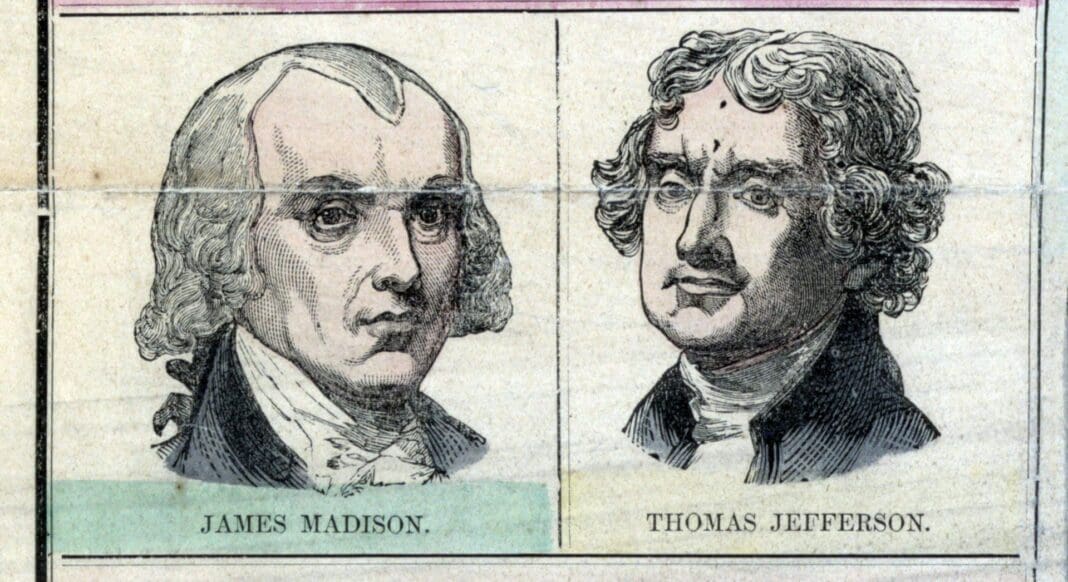
In that same decision, the justices also employed the metaphor of “a wall of separation between church and state,” a phrase borrowed from an 1802 letter from President Thomas Jefferson to an association of Baptist churches in Connecticut. At the time, the Baptists were a minority in a state that still maintained a religious establishment. Jefferson sympathized with their plight, employing the wall of separation metaphor to emphasize that “religion is a matter which lies solely between man and his God” and not to “the legislative powers of government.”
The idea of separate spheres of spiritual and secular functions and authority was advanced by religious and secular thinkers to benefit both religion and the state.
In his fifth century work “City of God,” St. Augustine advanced the model of two entities, one spiritual and the other temporal or earthly, each with separate authority and functions. Augustine went so far as to use an image of two walled cities separated from each other as a means to protect the purity of the church.
During the Protestant Reformation of the 16th century, both Martin Luther and John Calvin distinguished spiritual from earthly authority and called for a division of labor between the two. Luther distinguished “two kingdoms” – a spiritual kingdom and a temporal kingdom that had separate authority.
Similarly, Calvin wrote that “Christ’s spiritual Kingdom and the civil jurisdiction are things completely distinct” and, as such, “must always be considered separately” because of the great “difference and unlikeness … between ecclesiastical and civil power.”
At the same time, religious reformers were employing concepts of walls, hedges or other barriers to ensure that the secular and religious realms remained apart.
Protestant Anabaptists – Mennonites, Hutterites, Brethren – took the theological idea of separationism to heart, seeking to keep their communities apart from what they saw as the corruptions of the fallen world. They were declining to swear oaths of allegiance to civil authorities or otherwise participate in civic functions.
The early leader of the Mennonites, Menno Simons, used the term a “separating wall” to illustrate the degree of separateness their faith required from civil authority.
Finally, Roger Williams, the Puritan-turned-Baptist founder of Rhode Island, advocated for complete religious liberty. He called for maintaining a “hedge, or wall of separation, between the garden of the church and the wilderness of the world.”
Enlightenment figures, such as John Locke, also advanced notions of separation of church and state. In 1689, Locke wrote that the church must be “absolutely separate and distinct from the commonwealth and civil affairs. The boundaries on both sides are fixed and immovable.”
Influential British writer James Burgh called for building “an impenetrable wall of separation between things sacred and civil … the less the church and state had to do with one another, it would be better for both.” Scholars believe that this was likely one source for Jefferson’s famous 1802 letter to the Connecticut Baptists where he used the same metaphor.
Thus, members of the America’s founding generation were familiar with the concept of distinct spheres of authority between religion and government and the necessity of keeping those functions separate.
Even though Jefferson used the wall metaphor only once, he worked assiduously throughout his life to advance religious freedom via church-state separation. James Madison employed similar imagery, such as calling for “a great barrier” between the two.
Church-state separation wasn’t just an imagery idea; it was a concept that many people embraced. As Madison wrote, “religion & Govt. will both exist in greater purity, the less they are mixed together.”
As a result, to this day, many denominations and religiously affiliated groups, such as many Baptists, Seventh-day Adventists and members of Reform Judaism, among others, support the separation of church and state as essential for maintaining religious freedom.
And church-state separation continues to receive popular support. According to the Pew Research Center, in 2026, 54% of Americans say the government should enforce church-state separation – a consistent percentage – whereas only 13% believe it should stop enforcing it, down from 19% in 2021.
Despite this pedigree, the Religious Liberty Commission’s report expresses particular disdain for the “wall” metaphor, stating that “the ‘wall of separation’ phrase does not appear in the First Amendment or anywhere else in the Constitution.” The report calls it a “belabored metaphor” that “can wrongly imply that church and state are opposed to one another and must remain completely separate.”
The report also takes a narrow view of what is prohibited by the religion clauses: “that the government may not officially prefer one religion over another, take over the functions of a church, or coerce religious observance,” which would otherwise allow for other types of church-state intermixing such as government funding of religious education.
In her final opinion as a Supreme Court justice in 2005, Sandra Day O’Connor – a judicial conservative – reflected on the importance of church-state separation to guarantee full religious freedom.
“The First Amendment expresses our Nation’s fundamental commitment to religious liberty by means of two provisions – one protecting the free exercise of religion, the other barring establishment of religion.”
She concluded with a challenge: “Those who would renegotiate the boundaries between church and state must therefore answer a difficult question: Why would we trade a system that has served us so well for one that has served others so poorly?”
That the commission’s report ignores the benefit of church-state separation to American society is troubling.
This article is republished from The Conversation, a nonprofit, independent news organization bringing you facts and trustworthy analysis to help you make sense of our complex world. It was written by: Steven K. Green, Willamette University
Read more: In rebuke to Trump, Supreme Court upholds birthright citizenship, emphasizing the promise of equality in the Declaration of Independence What Jefferson and Madison would have thought about ‘rededicating’ the US to God How Jefferson and Madison’s partnership – a friendship told in letters – shaped America’s separation of church and state
Steven K. Green does not work for, consult, own shares in or receive funding from any company or organization that would benefit from this article, and has disclosed no relevant affiliations beyond their academic appointment.