

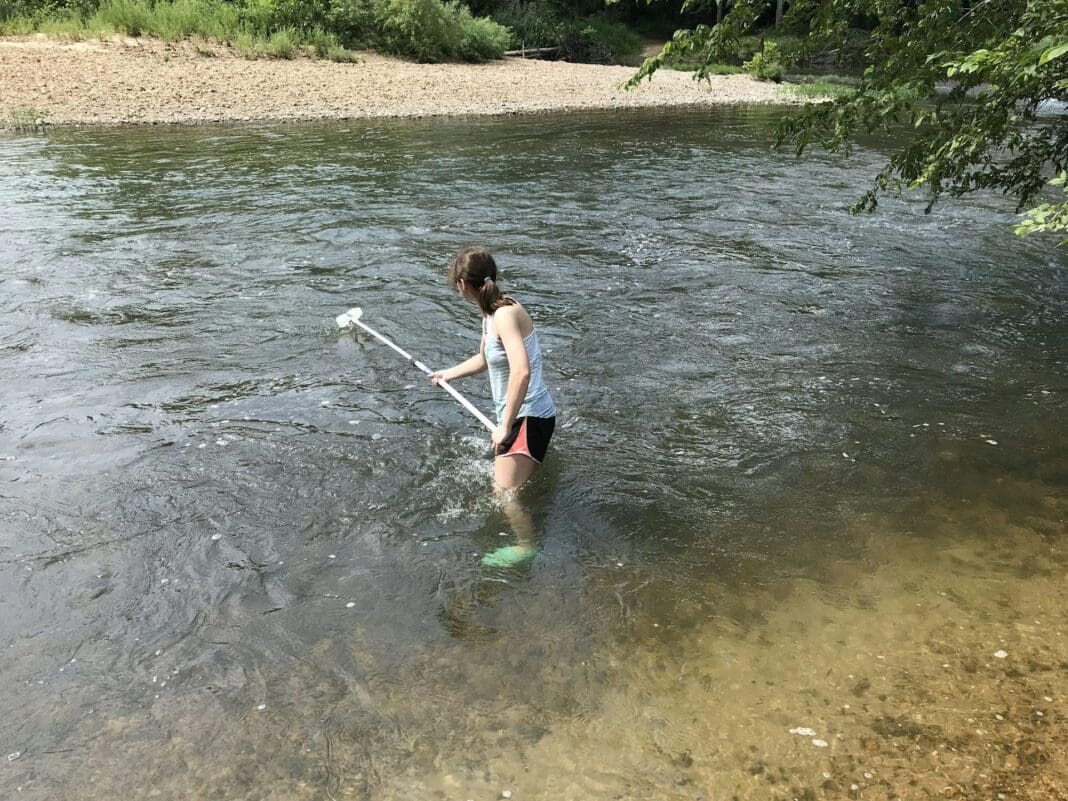
My students and I encountered a mystery. We were partnering with the Missouri Department of Conservation to monitor for fish presence and abundance in the Missouri Ozarks. We visited half a dozen rivers and streams across the region and collected a few cups of water from each.
We were testing for DNA in the environment to determine which species had left behind their genetic material and were therefore present in the stream. There was no need to capture or even see the species themselves. We were delighted to detect a variety of species in their appropriate habitats that are considered at risk in Missouri, including the lake sturgeon, crystal darter and Alabama shad. In the surface waters emerging from one large underground spring, we detected DNA from a cave-dwelling fish species that would never have been detected by researchers who caught or looked only for fish in the surface waters.
But there was a problem: We were certain we would find one particular species in every stream: the bleeding shiner (Luxilus zonatus), one of the most common fish in Ozark streams. To have confidence in our results we needed to understand why the bleeding shiner DNA did not show up in every sample, as we had expected. We checked our sampling technique, our water chemistry and other aspects of our testing.
In the data itself, we found a clue: The streams in which we detected bleeding shiner DNA all drained to the southern Ozarks, and the streams in which bleeding shiner DNA was not detected were all in the northern Ozarks. We could draw a line through the north-south drainage divide between those areas.
Some follow-up sleuthing revealed something we hadn’t known at the start: Northern Ozark bleeding shiners have a different DNA history from their southern relatives, even though the fish look identical and are, in fact, the same scientific species.
To human observers, the Ozarks can seem a relatively continuous landscape. For fishes, however, that landscape is divided into a series of separate drainage networks. Streams may arise only a few miles apart yet flow in opposite directions, ultimately connecting to entirely different river systems with distinct geologic histories.
Hundreds of thousands of years ago, the ancestors of northern populations interbred with another species of shiner, leaving behind a genetic signature of ancient hybridization that survives today, but only in certain drainages. Though they look the same, and were in rivers humans view as neighboring, these fish had distinctly different genetic histories.
We had been looking for just one DNA signature, assuming that all bleeding shiners would share that identity. Environmental DNA analyses like this can sometimes turn up unknown or unidentifiable sequences of DNA. When we looked more closely at those results, we were able to identify which previously unknown sequence corresponded to the northern populations of bleeding shiner.
Our findings were a concrete illustration that today’s rivers are products of ancient landscapes. During the glacial advances of the Pleistocene epoch – from about 2.5 million to about 12,000 years ago – some rivers repeatedly changed course.
Streams that are isolated today were once connected. Others that share a common geography and are ecologically quite similar today may have had entirely separate histories. The species that exist in rivers and streams today are the products of those long and complicated geological and evolutionary processes.
Specifically in Ozark streams, northern drainages that flow into the Missouri and Mississippi rivers were directly influenced by glacial advances that molded, modified, wiped out and recreated drainage connections and patterns of flow across the landscape.
In contrast, the southern Ozarks drainages were relatively isolated from disruptive glacial advances. South-flowing drainages, such as the St. Francis, Black, White and Spring rivers, contain more endemic species and genetically unique populations. Examples include the genetically distinct Black River walleye and numerous minnows, sunfishes and darter species that are unique to specific streams.
This project reminded my students and me that biodiversity monitoring by sampling DNA in the environment doesn’t just reveal what species are present.
The water samples we took contained records of the ancient landscapes that shaped those species. Every sample of river water is more than an inventory of life – it’s a window into the evolutionary history of an entire watershed.
This article is republished from The Conversation, a nonprofit, independent news organization bringing you facts and trustworthy analysis to help you make sense of our complex world. It was written by: David Duvernell, Missouri University of Science and Technology
Read more: Your local fishing hole is getting browner, changing which fish species thrive and which ones struggle Recreational fishing in the US catches far more fish than previously estimated How Imperial Japan turned to the sardine to help build a war machine
David Duvernell receives funding from Missouri Department of Conservation.