

One Saturday afternoon in May 2026, families gathered on Poklonnaya Gora, a hilltop war memorial park in western Moscow. They came for a procession and a “moleben,” an Orthodox prayer service, for the well-being of Russian families. Church media billed it as the first Day of the Sanctity of the Family.
May 30 is the feast of St. Evdokia of Moscow, a 14th-century princess who took monastic vows late in life after being widowed. Her husband, St. Dmitry Donskoy, a prince who led a victory over the Mongols, is commemorated on June 1. The church joined the two into a single couple’s feast in 2015, with a decree stressing that they were “parents of twelve children.”
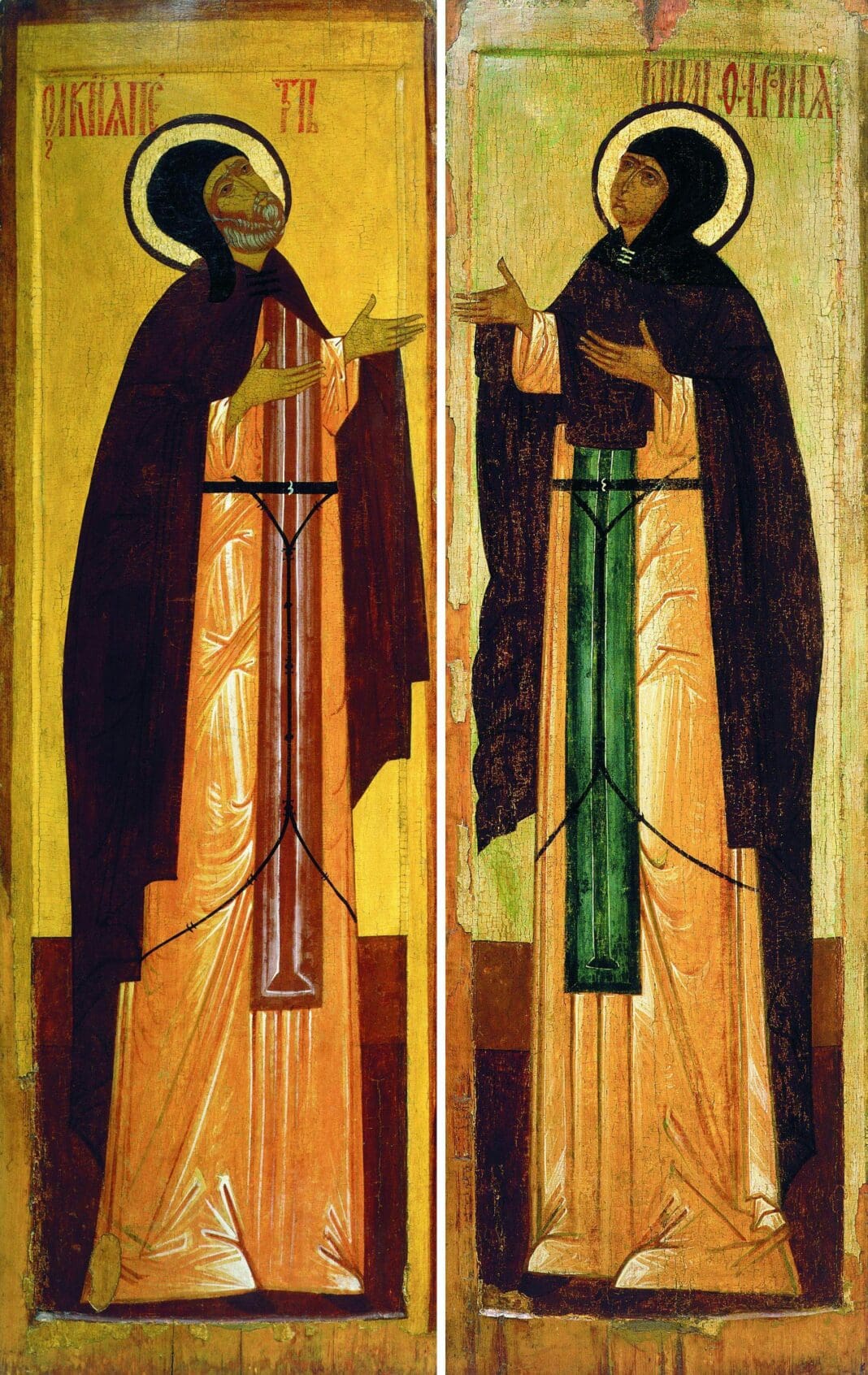
Just over five weeks later, Russians will celebrate another “holy couple.” July 8 honors Sts. Peter and Fevronia, a 13th-century prince and princess venerated as patrons of marriage and famed for their devotion to each other. First celebrated in 2008, the day became an official national holiday in 2022, though not a day off from work.
Both events serve a Russian government campaign to present itself as a defender of “traditional values,” a key part of my research as a scholar of marriage and sexuality in Russian Orthodoxy. The campaign is a partnership between church and state and is also meant to raise the birth rate. The Kremlin treats that goal as a matter of national survival, especially during the war in Ukraine.
Russia’s population has been shrinking for most of the past decade.
In recent years, deaths have outnumbered births by roughly 600,000 a year. As is true in many countries, fertility rates have fallen sharply. Russian women now average about 1.4 children each, far below the 2.1 needed to keep a population stable.
In the first quarter of 2026, demographer Alexei Raksha estimated there were about 272,000 births, the lowest for any quarter in roughly two centuries. Since then, the government has largely stopped publishing routine birth and death figures. Independent analysts, such as the U.S.-based Institute for the Study of War, offer two reasons for the blackout: the sheer scale of the decline and a wish to hide war casualties.
Those casualties are hard to count because Russia does not report them. Journalists at Mediazona and the BBC have confirmed the names of more than 230,000 Russian soldiers killed. A July 2026 analysis by the Center for Strategic and International Studies estimated as many as 450,000 Russian deaths and 1.4 million total casualties. Emigration compounds the losses: As of 2024, at least 650,000 Russians who left after the invasion were still abroad, many of them young and educated.
Officials increasingly speak in emergency terms. The Kremlin’s spokesman has called the birth rate “catastrophic.” President Vladimir Putin declared 2024 a national “Year of the Family” and has made reversing the decline a priority.
Yet Russia also has one of the world’s highest divorce rates. Marriage has fallen to its lowest level in decades. The pro-family imagery runs well ahead of the reality it is meant to change.
The push for “traditional values” – and babies – depends on a close alliance between the Kremlin and the Russian Orthodox Church. The summer “couples” days are no exception.
July 8, in honor of Peter and Fevronia, grew from a 2006 campaign in the city of Murom, a few hours east of Moscow. Peter once ruled the small principality, and the saints’ relics rest there. Thousands of residents petitioned for a national family day, and Svetlana Medvedeva, the wife of then-President Dmitry Medvedev, took up the cause. Medvedeva designed a chamomile emblem for the day and created a medal for couples married 25 years or more.
Officials and clergy promoted July 8 as a Russian answer to Valentine’s Day. The church calls that holiday an alien import meant to destroy the Russian family, casting it as a celebration of fleeting passion rather than committed love. Government pollsters say the share of Russians marking Valentine’s Day fell from 51% in 2005 to 30% in 2025.
For the Kremlin’s purposes, though, there is a problem with July 8: “The Tale of Peter and Fevronia,” written in the mid-16th century, contains no children. In fact, their marriage ends with the couple taking monastic vows: an awkward fit for a holiday about childbearing.
I and other scholars have argued that this awkwardness likely pushed the church to create a second “family” day. While Peter and Fevronia were childless, Dmitry and Evdokia, the May honorees, raised 12 children.
Dmitry and Evdokia were venerated separately for centuries – her on May 30, him on June 1 – until the 2015 decree that combined them. As the decree noted, June 1 falls on International Children’s Day. The government often invokes that occasion in anti-abortion campaigns.
In 2026, church outlets reported that May 30 would be observed as the Day of the Sanctity of the Family, part of a church-run “family week.” Organizers launched it in 2024, during the Kremlin’s “Year of the Family,” and a tight alliance of church, state and civic groups runs it.
Russia’s broader “values” program portrays the country as a bastion against Western ideas about family and gender, such as support for LGBTQ+ rights. It rests on a 2022 presidential decree that centers “traditional spiritual-moral values,” such as family and patriotism.
Other measures have followed. A 2024 law penalizes “childfree propaganda,” meaning the promotion of a childless life. A demographic strategy running to 2036 sets birth-rate targets. In December 2024, a new presidential council took charge of family policy.
Church leaders have also repeatedly called for a national ban on abortions in private clinics and criminal penalties for “inducement”: pressuring a woman to end a pregnancy.
The government has resisted that demand. But many regions have implemented clinic restrictions and local “inducement” bans, making abortion harder to obtain across much of the country.
This push for “traditional” families plays out continuously and has intensified since the invasion of Ukraine.
For example, on June 22, 2026, the anniversary of the 1941 Nazi invasion, the Orthodox channel Spas opened a week of programming about the birth rate. It was titled “Gde vse?!,” or “Where is everybody?!”
The channel’s director, Boris Korchevnikov, called it a “special demographic operation.” The phrase echoes how the Kremlin describes its war on Ukraine: a “special military operation.” He gathered demographers, health officials and clergy for televised talks.
This spring, Russia’s legislature began debating a bill that would fund fertility treatment for veterans and their wives. It would also fund treatment for war widows who have not remarried, and allow them to conceive using their late husbands’ stored sperm, with the men’s prior notarized consent.
The church has not endorsed this bill, however, and Feodor Lukyanov, chairman of the Russian Orthodox Church’s Patriarchal Family Commission, has objected that the arrangement would create an “incomplete family.”
But on May 30 and July 8, Russia celebrates families the church does approve of: holy couples whose days have been carefully built to carry a message about marriage and childbearing.
This article is republished from The Conversation, a nonprofit, independent news organization bringing you facts and trustworthy analysis to help you make sense of our complex world. It was written by: Diana Dukhanova, College of the Holy Cross
Read more: Russia’s drone pipeline: How Iran helps Moscow produce an ever‑evolving unmanned fleet Russia’s pared‑down Victory Day parade tells a story: Away from the pomp, war in Ukraine is not going to Putin’s plan As Russia ramps up ‘traditional values’ rhetoric − especially against LGBTQ+ groups − it’s won Putin far‑right fans abroad
Diana Dukhanova does not work for, consult, own shares in or receive funding from any company or organization that would benefit from this article, and has disclosed no relevant affiliations beyond their academic appointment.