

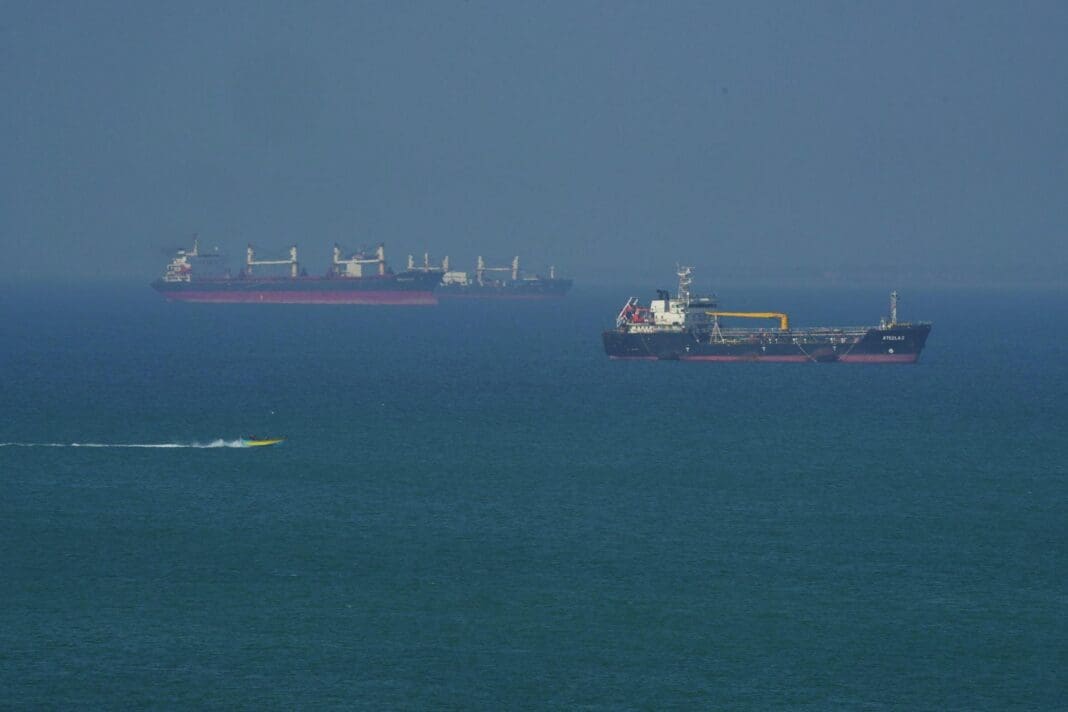
Few people want to get lost when traveling. But if there are places where being lost feels especially unsettling, they tend to be the sea, desert and sky. These environments share a defining feature: the absence of distinctive visual cues. Where horizons blur, landmarks disappear and every direction can look deceptively similar. Knowing where you are depends on information that you cannot see for yourself.
For most of human history, finding your way in such environments required skill, judgment and constant attention. Satellite navigation marked a fundamental shift. The advent of GPS has made navigation almost effortless: Press a button and voilà, location and heading appear instantly.
GPS’s great strength is that under benign conditions, it works remarkably well in precisely the environments where being lost would be most dangerous. Civilian systems routinely achieve meter‑level accuracy. This accuracy, however, masks a growing vulnerability.
Over the past few years, deliberate GPS interference has surged worldwide, disrupting maritime and aviation operations at an unprecedented scale. I’m an electrical engineer who studies alternative methods of electronic navigation. My lab and others around the world are developing these alternatives as backup for when GPS is unavailable or unreliable.
Jamming overwhelms weak satellite signals with noise or radio frequency signals, blocking GPS position and time altogether.
Spoofing is more insidious: Counterfeit signals surreptitiously replace authentic ones, misleading GPS receivers about location and timing while appearing to crews and automated systems to operate normally.
Interference arises from three sources: military activity, criminal exploitation and accidental misuse. In conflict zones, GPS disruption has become a routine tool of warfare, used to protect assets, degrade surveillance and counter drones. This activity is well documented across Ukraine, the Black Sea, the Baltic Sea, the eastern Mediterranean and the Persian Gulf. It routinely spills over to affect civilian ships and aircraft, and civilian life.
Accidental GPS jamming has caused serious disruption at international airports by making it difficult for aircraft and air traffic controllers to track traffic in and out of the airports. Intentional GPS spoofing was even used in a highway heist to steal US$1 million worth of restaurateur Guy Fieri’s tequila.
Making matters worse, spoofed GPS data does not remain confined to a single system. Ships use the Automatic Identification System to broadcast their locations and to see what other ships are nearby to avoid collisions. The system broadcasts a ship’s GPS position information along with the ship’s name, course and speed, classification and call sign.
GPS spoofing effectively corrupts Automatic Identification System signals, sending false position information to nearby vessels, shore authorities, insurers and commercial tracking services. This activity can create fleets of “ghost ships” that appear real to others navigating nearby.
Criminals use GPS interference to block or alter Automatic Identification System information to evade oversight. Illegal fishing fleets, oil smugglers, sanctions evaders and maritime sand thieves have been repeatedly linked to falsified or disrupted Automatic Identification System and GPS signals.
GPS intereference is not new, and the U.S. government warned about it decades ago, but the scale of its impact has significantly accelerated over the past few years. GPS spoofing and jamming incidents affecting civil aviation increased by about 500% from January to August 2024.
Maritime authorities reported hundreds of ships affected daily, with groundings and collisions in 2024–25 publicly linked to interference of GPS and other satellite navigation systems, including in the Baltic Sea and the Strait of Hormuz.
The consequences have claimed lives. In December 2024, Azerbaijan Airlines Flight 8243 was struck by a Russian air-defense system, killing 38 people after the flight was diverted due to GPS interference. At sea, GPS interference in the Strait of Hormuz has caused oil tanker collisions.
Disruption has also forced runway closures, mass flight diversions and emergency procedures at Newark Liberty, Dallas-Fort Worth and Denver international airports.
Even senior officials are not immune: In 2025, GPS jamming forced an aircraft carrying the European Commission President Ursula von der Leyen to make an emergency landing.
Recent incidents in the Strait of Hormuz during the U.S.-Iran war mark a decisive escalation in the risk posed by GPS interference. The strait sits at the intersection of intense geopolitical conflict and one of the world’s most critical maritime choke points. Around 20% of global petroleum trade transits these narrow waters each day, alongside dense commercial traffic. There’s little margin for navigational error. Here, even modest mistakes in position or timing can rapidly escalate into collisions, groundings or environmental disasters.
The Iran war has led to sustained spoofing across the Persian Gulf. Ships have reported positions via Automatic Identification System that place them on land or otherwise miles from their true locations without triggering alarms.
In the confined waters of the Strait of Hormuz, where ships pass one another in close proximity, GPS interference erodes situational awareness precisely where it matters most.
Crucially, interference in Hormuz is persistent rather than episodic. Reports show jamming and spoofing used systematically over extended periods, not merely as short-term responses to specific incidents. This pattern suggests that GPS disruption has become routine practice rather than a niche capability in electronic warfare.
Once normalized in one of the world’s busiest sea-lanes, such practices are difficult to contain geographically. The result is a navigation environment in which people can no longer fully trust position, timing and identity at sea. The consequences extend far beyond the confines of the Persian Gulf.
The normalization of GPS disruption exposes a deeper issue: Modern navigation resilience has been built around the assumption that GPS signals are usually available and trustworthy. As that assumption erodes, attention has shifted from hardening GPS toward security through diversification. This means drawing navigation information from fundamentally different signals.
For a backup to satellite navigation, several countries, including the U.K., France, Saudi Arabia, Russia, South Korea and China, are deploying or modernizing long-range radio navigation, or LORAN, a system that dates back to World War II.
Another alternative that has gained increased interest over the past decade or so is using signals never intended for navigation, referred to as signals of opportunity. In contrast to dedicated navigation systems, such as long-range radio navigation, this approach uses existing infrastructure and preserves scarce radio spectrum. A particularly fruitful type of signal to exploit is terrestrial cellular.
My lab has demonstrated this type of navigation with ground vehicles, unmanned aerial vehicles, or UAVs, high‑altitude balloons and aircraft, including in GPS‑jammed environments. We developed specialized receivers that exploit signals from existing LTE and 5G cellular networks.
We have demonstrated sub‑meter accuracy on UAVs, near-lane‑level accuracy on ground vehicles, and meter-level accuracy on aircraft and high-altitude balloons, without cooperation from cellular network providers.
Another approach leverages the rapid proliferation of constellations of low Earth orbit communication satellites. Compared with GPS signals from medium Earth orbit, low Earth orbit satellites offer stronger signals, are numerous, transmit in a much wider swath of the spectrum, and their signals are more resilient to wide-area disruption.
We demonstrated meter-level positioning accuracy exploiting signals transmitted by Starlink satellites. We then developed receivers that can passively listen to signals emitted from multiple low Earth orbit satellite constellations.
Since then, my lab has demonstrated navigation with low Earth orbit satellites across the U.S. In our latest experiment, we successfully navigated a vessel in the Arctic seas, off the coast of Greenland.
These results point to a pragmatic solution: Navigation resilience will come from a diversity of techniques. We and others are already demonstrating the technologies to do so. Whether they are put into practical use is now a matter of policy, regulation and timing.
This article is republished from The Conversation, a nonprofit, independent news organization bringing you facts and trustworthy analysis to help you make sense of our complex world. It was written by: Zak Kassas, The Ohio State University
Read more: When GPS lies at sea: How electronic warfare is threatening ships and their crews Why shadow tankers are the only ships still moving through the Strait of Hormuz Solar storm knocks out farmers’ high‑tech tractors – an electrical engineer explains how a larger storm could take down the power grid and the internet
Zak Kassas receives funding from the Office of Naval Research, Air Force Office of Scientific Research, US Department of Transportation, NASA, Sandia National Laboratories. He is affiliated with The Ohio State University and is a Fellow of the IEEE and the ION.