


Curious Kids is a series for children of all ages. If you have a question you’d like an expert to answer, send it to CuriousKidsUS@theconversation.com.
What really happened at the end of the Revolutionary War? – Veda, age 11, Crystal Lake, Illinois
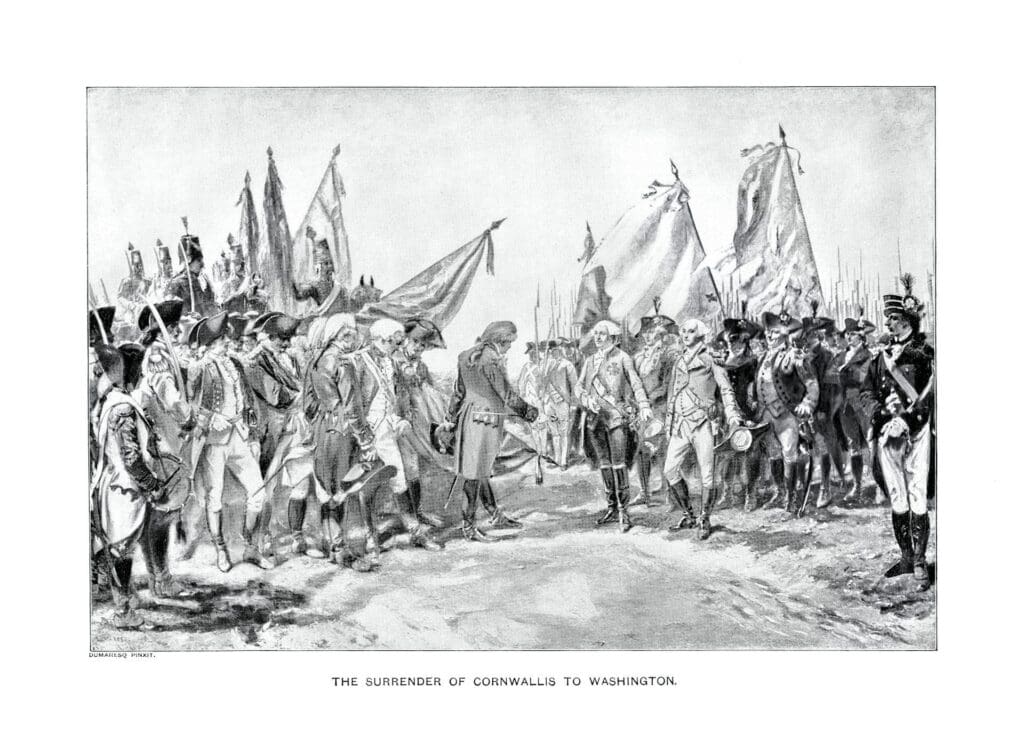
In the autumn of 1781, a tired Continental Army of American and French soldiers pushed the British army through the Carolinas to the coast of Virginia. For three weeks, the Continental Army trapped the British against the sea while the French navy fought the British navy.
Surrounded, the British surrendered on Oct. 19, 1781, at the Battle of Yorktown, the last major military fight of the American Revolution. America had won the war.
No one had expected that a handful of colonies could defeat the mighty British Empire. Once news of the American victory reached London, peace talks began in 1782, with the Treaty of Paris finally signed in 1783.
In the immediate aftermath of the American Revolution, the economy was in shambles, 25,000 Americans had died, and chaos erupted as over 60,000 Loyalists who had stayed devoted to Great Britain and George III, including more than 15,000 formerly enslaved people who had joined the British army, left the United States.
The question then became: “What’s next?” Building a nation was very different from fighting a war. And it didn’t happen overnight.
During the Revolutionary War’s six years of fighting, individual states wrote their own constitutions, which set up how their governments would work. Early on, in 1777, the newly named United States embraced the Articles of Confederation and Perpetual Union. These laid out the first system that organized all the states under one umbrella in order to create a unified front of Americans during the Revolution. They were not a constitution because they didn’t create a formal government.
The Articles of Confederation set up a framework that was OK during wartime but too weak for building a new nation. They didn’t call for a president to lead, and they didn’t set up a court system to hear cases when laws were broken. They provided no way to establish foreign policy and didn’t say how states should trade with other countries or how to impose taxes on things Americans bought from abroad.
The new country fell into economic crisis, highlighting the weaknesses of the government. Before the American Revolution, white American colonists enjoyed one of the highest standards of living in the Western world. But war debts, inflation and a temporary stop to profitable trade with the enormous British Empire left Americans scrambling to get by in the 1780s.
So, representatives from each state gathered at Independence Hall in Philadelphia during the summer of 1787 to discuss how to improve the national government. They agreed on a government that would rely on checks and balances, with power spread out among different branches.
They called for a legislative branch with two houses – the House of Representatives and the Senate – to make laws. There would also be an executive branch with an elected president and vice president. And there would be a judicial branch with a Supreme Court of nine justices committed to upholding the newly written Constitution.
They laid everything out in the United States Constitution, which went into effect in 1789. Right away, the House of Representatives began drafting amendments outlining individual freedoms and protected rights for citizens, a hearkening back to the Declaration of Independence that had announced the colonies were breaking free of Great Britain back in 1776.
The Bill of Rights was approved in 1791, guaranteeing American citizens free speech, freedom of assembly, freedom of religion, freedom of the press, individual privacy and property, and the right to a public, speedy trial with a jury of peers, among other protections.
These rights are still the law of the land today.
The Constitution called for a president to be elected, but who voted? You could vote in 1789 only if you were male, white, a landowner, over the age of 21, and not a Quaker, Jew or Catholic. These requirements excluded the majority of people in the new United States. The Naturalization Act of 1790 explicitly limited national citizenship to only white people. What about everyone else?
Using the language and promises of the Declaration of Independence, various groups advocated for rights after the American Revolution.
African Americans petitioned for freedom in the northern states, with varying success. States geographically above Maryland began the process of immediately or gradually abolishing slavery, beginning with Vermont in 1777 and culminating with New York, the longest holdout, in 1799.
It was not until the 13th Amendment to the Constitution was ratified in 1865 that slavery ended, quickly followed by the 14th Amendment in 1868 that gave citizenship to “all people born or naturalized” in the United States. The 15th Amendment in 1870 extended the vote to all American men, regardless of race, but women were still left out.
Women had served in the American Revolution in a variety of ways: nursing, spying, organizing boycotts, following the camps to provide domestic support, as well as staying behind to maintain farms, businesses and homes. Although white women were considered citizens and received expanded educational opportunities after the Revolution, women of color were excluded. Women were not guaranteed the right to vote until 1920 with the 19th Amendment.
Native Americans faced enormous obstacles during and after the American Revolution. The Treaty of Paris in 1783 that formally ended the war extended the boundary of the United States to the Mississippi River and to Canada. That expansion meant Native Americans in those areas quickly lost lands and experienced extreme violence as American settlers flooded into the newly opened areas.
Individual tribes negotiated with the United States with little success. It was not until 1924, with the passage of the Snyder Act, that all Native Americans became recognized citizens of the United States.
Relying on the hopes outlined in the Declaration of Independence, Americans fought and continue to fight for freedom and representation. Promises made in the Declaration of Independence, the Constitution and the Bill of Rights reflect an ever-evolving America, always with the hope of life, liberty and the pursuit of happiness for all.
Hello, curious kids! Do you have a question you’d like an expert to answer? Ask an adult to send your question to CuriousKidsUS@theconversation.com. Please tell us your name, age and the city where you live.
And since curiosity has no age limit – adults, let us know what you’re wondering, too. We won’t be able to answer every question, but we will do our best.
This article is republished from The Conversation, a nonprofit, independent news organization bringing you facts and trustworthy analysis to help you make sense of our complex world. It was written by: Sandra Slater, College of Charleston
Read more: How did Uncle Sam become a symbol for the United States? What happened to Confederate money after the Civil War? During the American Revolution, Brits weren’t just facing off against white Protestant Christians − US patriots are diverse and have been since Day 1
Sandra Slater does not work for, consult, own shares in or receive funding from any company or organization that would benefit from this article, and has disclosed no relevant affiliations beyond their academic appointment.
