


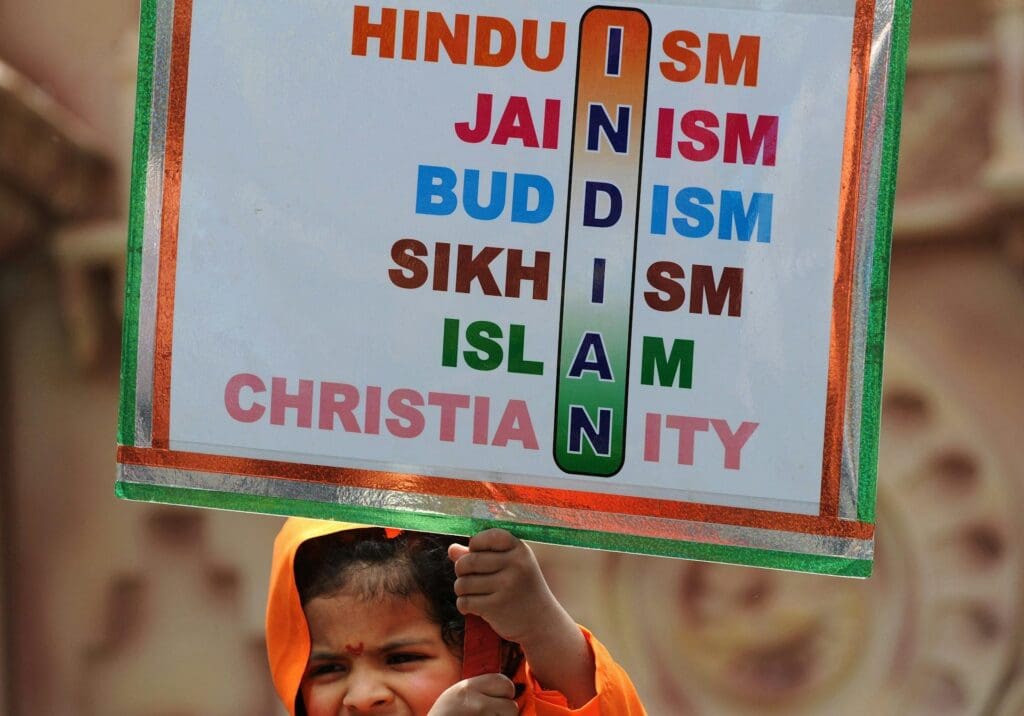
The growing assertion of a majority Hindu identity is fueling debates about religious pluralism in India. A 2025 Washington-based research group report documented a steady, incremental increase in hate speech since 2023 targeting religious minorities in India, while Human Rights Watch reported a rise in religious and communal violence in 2024. Much of this rhetoric and violence has been justified as defending religious identity.
When India became independent in 1947, its constitution affirmed a commitment to religious diversity and pluralism as a national ideal.
India is one of the world’s most religiously diverse countries. While a majority of its population is Hindu, it is home to the world’s third-largest Muslim population – nearly 172 million. Christians, Sikhs, Jains and many indigenous traditions also form part of its rich religious landscape.
As a scholar of late 18th- and 19th-century India, I have studied everyday writings, military records and diaries from the period. They reveal that India was imagined as a sacred land in different ways. Two accounts illuminate this way of being – the memoirs of a Hindu soldier, born in a small village, and those of an elite Muslim poet from Delhi. Despite their different backgrounds, they describe a region where religious identities coexist with multiple forms of belonging.
Sitaram Pande, a soldier in the Bengal Army of the British East India Company, wrote a memoir about his travels and time in military service.
His experiences span the years leading up to and after the revolt of 1857. That year, Indian soldiers serving the British East India Company rebelled against the British commanding officers, killing many of them and sparking an uprising that spread rapidly across much of northern India. After a prolonged siege and fighting, the British recaptured Delhi and brutally suppressed the rebellion. In its aftermath, India was brought under direct control of the British Crown.
Pande served in the East India Company army in the British invasion of Afghanistan in 1838. He uses the term “Hindustan,” commonly used in writings of the time, to refer to the land east of the river Indus.
For Pande, Hindustan, which includes territories taken over by the British, is a space of beauty, romance and adventure. “Home” is the village he grew up in in north India and leaves to join the army; everything outside it in Hindustan is the “world.” As he notes, “It was 10 October 1812, and at six o'clock in the morning I … left my home to enter what for me was an unknown world.”
He describes cities he travels through in Hindustan in romantic terms, borrowing from the paradise-like landscapes, where land is depicted in the lush, idyllic ways of Sanskrit poetry. Thus, in the city of Jaipur: “Cuckoos were singing on the mango trees, and peacocks strutted about in shady places.”
Pande is a Brahmin and practices Hindu dietary and ritual practices, such as traveling with his own pots and cookware, in order to draw water from the well and cook his food. At the time Brahmins, traditionally, could accept only food cooked by another Brahmin. When he returns from Afghanistan, he has to perform a prayer to be allowed to return to his village, as he has ventured beyond the sacred geography of Hindustan.
Yet, during his travels he rescues a Hindu woman forced to be the mistress of an Arab mercenary and marries her. He goes against prevailing norms of sexual and religious purity. The woman is not a Brahmin and is considered sexually “impure” – because she is not a virgin – as per prevailing norms.
In a chapter titled “The Lovely Thakurin,” Pande describes how he rescues the woman from her captor and places her in the care of the regiment. Gradually, his “heart became inflamed with love,” and though he is warned she will bring “disgrace,” he decides to marry her.
His account reveals a sacred landscape that borrows descriptions from and echoes the ethos of sacred Sanskrit texts. At the same time, it shows that his life and sense of belonging extend far beyond that religious identity.
The poet Mirza Ghalib’s memoir, “Dastanbuy” – loosely translated as a “bouquet of flowers” – is an account of his years in Delhi during the revolt of 1857. The city was the site of prolonged fighting between rebel Indian forces and the British East India Company army. The Mughal empire – the Islamic dynasty that had ruled much of northern India since the 16th century – was in its final years. After British forces recaptured Delhi, much of the city was destroyed and the last Mughal emperor Bahadur Shah Zafar was exiled.
For Ghalib, Delhi was a cosmopolitan city where Hindus, Muslims and the British lived and worked side by side. As he notes, here “we composed our verses and compiled our diwans (collection of poems).” Ghalib was a devout Muslim yet drank wine despite Islam’s prohibition on alcohol. In his poetry and in his letters, he expresses a belief in the “peaceful coexistence” for all faiths.
Ghalib describes Delhi as a “garden” underneath the “stars” of the “Lord, the Emperor,” Bahadur Shah Zafar. In the Quran, paradise is described as an ideal garden. In practice, the Mughals in India, from the 15th century onward, had a rich tradition of landscaping and building waterfront and palace gardens, modeling themselves after heavenly authority and their cities after the heavenly garden. Delhi, with its palaces, forts and gardens, echoed this ethos. Ghalib describes the city, prior to its destruction by the British in 1857, in idyllic terms as “filled with tulips and the scent of roses.”
Ghalib’s memoir presents an Islamic vision of the garden through Delhi. At the same time, his identity as a cosmopolitan elite went beyond religious boundaries.
The historical look back shows that religious identities are rarely pure and that India’s sacredness has rested in religious imaginations of multiple faiths.
I believe present-day arguments that justify anti-minority violence and rhetoric in the name of defending “pure” religious identities ignore that historical sacredness.
This article is republished from The Conversation, a nonprofit, independent news organization bringing you facts and trustworthy analysis to help you make sense of our complex world. It was written by: Aishwarya Lakshmi, Rice University
Read more: The Taliban has brought Afghanistan close to collapse, but resistance is growing 75 years ago, Britain’s plan for Pakistani and Indian independence left unresolved conflicts on both sides – especially when it comes to Kashmir How a British royal’s monumental errors made India’s partition more painful
Aishwarya Lakshmi does not work for, consult, own shares in or receive funding from any company or organization that would benefit from this article, and has disclosed no relevant affiliations beyond their academic appointment.
